
A clear path onto Microsoft Fabric.
We start with an assessment and roadmap, move your Power BI models onto Fabric, prepare your data for AI with the right governance, and manage the platform afterward.An assessment and roadmap first, then migration, governance, and managed support.
Fabric rewards a plan
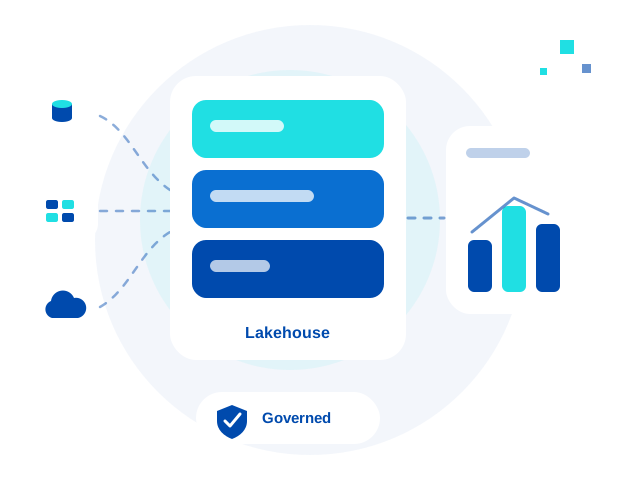
Microsoft Fabric brings data engineering, warehousing, and Power BI together on one platform that runs on shared capacity, the computing power you pay for. That's powerful, and it also means the architecture, capacity, and cost decisions you make early are hard to undo later.
We help you decide what belongs in Fabric, how much capacity you'll need, and in what order to move, before you spend. Then we help you carry it out and, if you want, run it. Work beyond our defined services is scoped as custom work.
What you know after the Assessment
Which workloads belong in Fabric, the capacity you'll need and roughly what it will cost, and a phased order to move things in, so you decide the pace.
What we do
Four ways to work together, from a planning assessment to ongoing management.
Fabric Migration Assessment
A two-to-three-week architecture plan with a capacity and cost estimate and a phased roadmap for moving to Fabric.
About the AssessmentPower BI to Fabric Migration
Moving your Power BI semantic models (the shared definitions of your data and calculations behind reports) and reports onto Fabric, including Direct Lake (a Fabric feature that lets Power BI read data straight from Fabric storage) where it fits, with testing so your reports keep working.
Governance & AI Readiness
Microsoft Purview (Microsoft's data governance service), access controls, and data quality, so your data is ready for Copilot (Microsoft's AI assistant) and other AI, and sensitive data stays properly controlled.
About Governance & AI ReadinessManaged Fabric
Capacity and cost monitoring, fixes for failed pipelines (automated jobs that move data) and refreshes, tuning, access administration, and a monthly report on how the platform is performing.
How a typical path looks
Most organizations start with the Assessment and move at their own pace from there.
Assess
We review your current environment and work out the architecture, capacity, and cost for Fabric.
Plan
You get a phased roadmap, so you can decide what to move, in what order, and when.
Move
We migrate your Power BI models onto Fabric, and scope any further build work with you as custom work.
Govern & run
We put access controls and data quality in place, and, if you want, manage the platform month to month.
Signs you need this
- You use Power BI and aren't sure whether Fabric is worth the move
- A Fabric trial or pilot has grown without a clear plan
- Capacity costs are hard to predict or explain
- Pipelines or refreshes fail and nobody owns fixing them
- Leadership wants Copilot or AI, but you're not sure your data and access controls are ready
- Nobody can say with confidence who has access to which data
What we work with
Common questions
Not always, and answering that honestly is part of what the Assessment is for. If Fabric isn't the right fit for you, the roadmap will say so.
Two to three weeks. You get an architecture plan, a capacity and cost estimate, and a phased roadmap.
Yes. Migrating your Power BI models is a defined service. Other build work, such as new data pipelines, or warehouse and lakehouse builds (the stores your data is organized in), is scoped with you as custom work. Tell us what you're planning and we'll talk it through.
Capacity and cost monitoring, fixes for failed pipelines and refreshes, tuning, access administration, and a monthly report. It can also be combined with SQL Server and Power BI support through Complete Care.
Managed plans include a response within 3–4 business hours, Monday to Friday, 9 AM to 6 PM Eastern. After-hours support is available by agreement, with a response within 3–4 hours. Response time is how quickly a qualified person engages with your request, not a guarantee of how quickly an issue is resolved.
Explore our other services
Fabric is one of three areas we cover with a single team.
Start with a Fabric Migration Assessment.
A two-to-three-week architecture plan with a capacity and cost estimate and a phased roadmap.
Request a Fabric Assessment